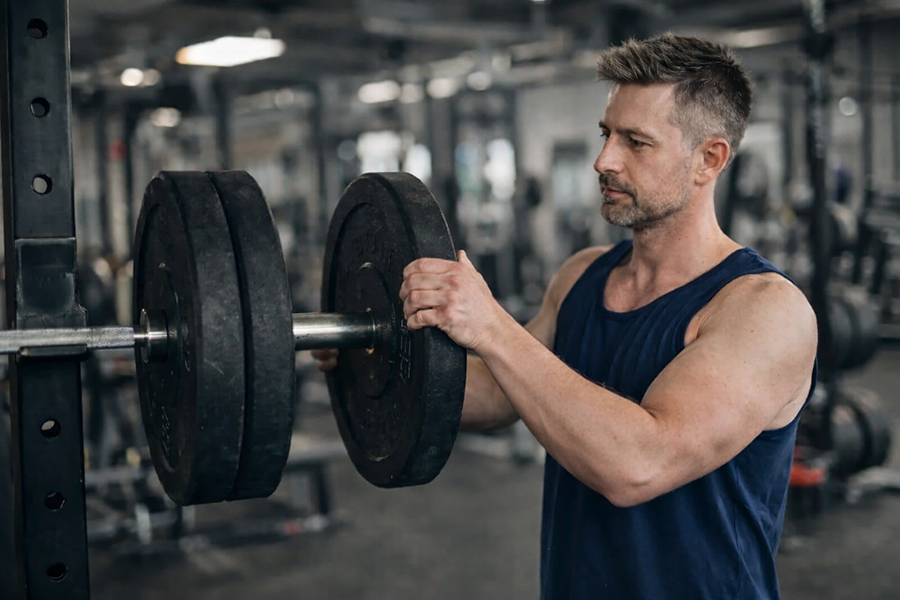
Do muscle mass gains always follow strength gains? How do lean powerlifters stay in the same weight class but keep lifting heavier? How do bodybuilders get bigger when they’re not lifting heavier? If your strength is down in a workout (no personal bests) does that mean your workout wasn’t productive and you won’t gain muscle? Here’s the short answer:
If you get stronger, will you get bigger? Usually yes, but not always, and it’s not always necessary to lift heavier to gain muscle.
There’s a close interaction between muscle gain and strength gain and vice versa. Getting stronger helps you gain muscle size and gaining muscle size helps you get stronger. But it’s not a one-to-one relationship, and this is where a lot of people get misled.
It would be more accurate to say that muscle gains correlate with strength gains.
The Myth About Getting Stronger That Won’t Die
You’ve probably heard this before: “just get stronger and you’ll get bigger.” There’s truth to that. But the statement is incomplete – and sometimes flat-out wrong.
In fact, if you take that advice too literally, it can actually slow down your muscle gains or worse, beat up your joints while still not giving you the physique you want.
Almost everyone who lifts weights should try to get stronger. That’s not the issue. The mistake is thinking that adding more weight to the bar is the only way to gain muscle. It’s not. You can have productive, progressive workouts – and get bigger – even when the weight doesn’t go up.
Why This Matters Especially As You Get Older
This is especially important if you’re past your 40s, or even your late 30s. At some point, constantly pushing heavier and heavier loads stops working as well, increases injury risk, and starts to feel like you’re grinding your joints into dust.
I’ve been there, and I can tell you from experience – as well as the research – that chasing heavier weights at all costs is not the smartest way to train for muscle size, especially long-term.
Strength Training Vs Size training: Similar But Not The Same
I’ll break down the science in a minute, but here’s the key idea:
- Strength is influenced heavily by your nervous system.
- Muscle size is influenced by multiple growth mechanisms, not just heavy weight.
That’s why you can get stronger without getting much bigger, and you can get bigger without lifting heavier.
Getting stronger is a good thing for many reasons, and it usually does lead to increased muscle gains. But it’s not the only path to muscle growth, and it’s not always the best one, depending on your goal.
Not Everyone Wants To Be A Weightlifter Or Powerlifter
Many trainers and coaches today push their clients hard to get stronger. I may be biased because I’m a bodybuilder, not a powerlifter, but I think there’s too much emphasis placed on heavy weight, low rep maximal strength training these days.
Personally, I couldn’t care less how much I bench. I just want a good physique, great health, and enough strength to be functional in life as I get older. For many people, especially as they pass middle age, maximal strength training is not only not their interest, it’s too much stress for their joints anyway.
You should choose your own number one health and fitness priority; don’t let either a strength coach or a bodybuilding coach choose your goals for you.
If you’re a powerlifter or Olympic lifter, it’s your primary goal and your job to get stronger. If you’re a physique athlete, it’s your primary goal and your job to build muscle and look better. If your goal is general health and fitness, you’ll probably want a little bit of both – strength and muscle.
If you want to, you can pursue both – strength and muscle go together quite well and usually develop at the same time anyway. Just keep in mind that bodybuilders and powerlifters don’t train the same way, because they each have different goals. To optimize achievement of either goal requires specialized training with a primary focus on one or the other. That’s the law of training specificity.
How To Gain Muscle Without Maximum Weights
For bodybuilding or gaining muscle, the general advice to increase the weight progressively whenever you are able to over the course of your training career is absolutely correct. Progressive overload is a key driver of muscle growth – but increasing weight isn’t the only muscle increasing factor.
If you’re a bodybuilder or your primary goal is muscle size or physique development, you can’t always count on getting bigger just because you’re getting stronger. This is especially true if you only train heavy in the low rep ranges with long rest periods between sets. That’s because the mechanisms of muscle growth go beyond lifting more weight for low repetitions.
Developing muscle size is influenced by the amount of weight you lift because the amount of mechanical tension you place on the muscle is one of the three primary mechanisms of muscle growth. But developing muscle size (hypertrophy), is also governed by metabolic stress and muscle damage, not just tension alone.
Training with the bodybuilding style of workouts – a lower frequency of working each muscle group, shorter rest intervals between sets, a higher volume of work and higher number of reps – produces more metabolic stress and muscle damage than training with the powerlifting style. It also stimulates more blood flow and a bigger pump which leads to greater capillarization within the muscles. That answers the question of why bodybuilders usually carry more muscle size.
Now, about the other question I posed at the beginning of this post…
How Is It Possible To Get Stronger Without Getting Bigger?
One of the biggest reasons you can get stronger without gaining size or body weight is because developing strength is governed in large part by your nervous system getting more efficient, not just from a larger muscle cross-sectional area.
In a beginner especially, the majority of the initial strength gains are neural. The beginner’s nervous system is just getting started in learning how to fire off neural signals to the muscles – stronger, more coordinated signals that make the muscle contract harder and more efficiently.
This is why many lifting coaches say, “strength is a skill” and you “learn” how to do each lift better with practice and time, like any other skill. How do you get stronger without getting bigger or heavier? Practice. Practice the lifts often (higher frequency), practice the lifting technique to perfection, strive for progressive overload as your top priority, and over time your nervous system and muscular system together develop the “skill” of lifting more weight.
Furthermore, when you use very heavy weights in range of 1 to 5 repetitions per set, those types of heavy loads are more neurally demanding. When you combine that type of repetition and loading scheme with longer rest intervals, you don’t involve the energy systems and metabolic processes that optimize hypertrophy as much as if you did higher reps with shorter or moderate rest intervals.
You can’t expect to always get stronger though, and you should never get discouraged if you have workouts where you can’t increase the weight. In fact, it’s not normal to get stronger continuously. It’s normal to make gains for a while and plateau. You then do something to break the plateau and hopefully, continue to use progressive overload to keep getting even stronger.
When You Can’t Get Stronger And You Plateau, What Then?
As an advanced lifter, more sophisticated training strategies are required than just “add 5-10 pounds to the bar every workout.” That is standard and correct beginner advice, but it’s too simplistic for advanced athletes, and is literally impossible to achieve forever. To keep getting stronger, advanced strength athletes have to know when to push hard and when to back off the intensity or when to take one step back to take two steps forward.
Basically we’re talking about graduating from simple programs with linear progression into advanced programs using periodization and much greater variety. Progression and periodization for advanced lifters is explained in all the good powerlifting and strength training books. It’s beyond the scope of this post to get into details, but here are two examples of what you might do when your strength plateaus:
1. Start taking de-loads once every 4th week (increase intensity for 3 weeks, then back off for a week)
2. Train straight through, increasing weights continuously until you miss your goal reps two workouts in a row, then back off 10-15% in weight and build back up
People with muscle size building goals also need to make their programs more sophisticated as they get more and more advanced. One way to do that is to vary the rep range (and the corresponding weight load).
Rep Ranges For Getting Stronger Vs. Getting Bigger
1. Low reps (heavy weight) for strength
2. Medium reps (medium weight) for hypertrophy
3. High reps (light weight) for endurance / metabolic effect.
The middle (hypertrophy) rep range is usually 8 to 12 reps. In the past, it was believed that for optimal muscle growth, you should train mostly in that muscle building “sweet spot” – that 8 to 12 rep bracket. But you’re not limited to using only one rep range, and today most bodybuilding trainers will agree that using both the strength and the hypertrophy rep ranges (with a small amount of high rep for pump and metabolic effect), is probably ideal for muscle growth.
Conversely, it was previously believed that if you trained mostly in the low rep ranges (4 to 6 give or take a rep), you’d get maximum strength increase, but probably not maximum muscle size increase.
However, based on the latest studies, it appears that if you do enough sets in the low rep ranges, so that the volume over each week is more or less equalized, you can probably gain as much muscle as if you worked in the hypertrophy 8 to 12 rep range. The difference is, you will be stronger than if you only train in the hypertrophy range.
Another way to increase muscle size while doing a strength or power program, is to add some bodybuilding-style hypertrophy work at the end of your workout, after you’ve done the heavy stuff first.
A weight lifter who trains entirely with low reps (with heavier weight) and doesn’t do a lot of volume or doesn’t add any hypertrophy work is rarely going to have the physique of a bodybuilder unless he or she has crazy muscle building genetics (a natural mesomorph), not to mention a really good diet.
An Important Point About What It Means To “Get Stronger”
One, let me clarify what “getting stronger” means. As mentioned above, most people think that heavy weights and low reps, like 3-5 reps, is for building strength. However, if you’re training for bodybuilding and if you increase the amount of weight you can lift for 10 reps, did you get stronger? You sure did! You increased your 10 rep max strength.
However, a lot of coaches and athletes think that getting stronger only means heavy weight and low reps. They don’t acknowledge that if you lift more weight in any rep range, you’ve gotten stronger. So remember, you can use progressive overload (increasing weights whenever you can) regardless of the primary repetition range you train in.
Two, it’s also worth mentioning that if you are gaining or even simply maintaining strength during a cutting phase, that is usually a good sign that you are also retaining lean body mass, even though it is not a direct assessment of lean body mass. If your strength is falling during a fat loss diet, that is not a good sign. It’s always a good thing to at least maintain your current strength level, especially when cutting.
The Bottom Line On Training For Strength Vs. Training For Muscle Size
Strength gains are a good thing that help lead to muscle growth, and correlate highly to muscle growth, but it’s very possible for your strength to go up without muscle mass going up.
It’s also possible to increase your muscle mass without increasing your strength (without lifting heavier) and there are many “progressive overload” techniques for doing that.
– Tom Venuto, author of Burn The Fat, Feed the Muscle.
PS. If you want to learn more, then download a copy of my Progressive Overload Training Manual. If you want to gain more muscle size, the real key is progressive overload. In fact, did you know there are 7 major progressive overload weight training methods you can use to gain muscle – without lifting more weight? You learn them all in my new training manual.Click Here and pick up your copy today
References
Schoenfeld BJ, Ratamess NA, Peterson MD, Contreras B, Sonmez GT, Alvar BA. Effects of different volume-equated resistance training loading strategies on muscular adaptations in well-trained men. Journal of Strength And Conditioning Research. 2014 Oct;28(10):2909-18.
Erskine RM, et al. The contribution of muscle hypertrophy to strength changes following resistance training. European Journal of Applied Physiology, 114: 1239-1249, 2014
 About Tom Venuto
Tom Venuto is a lifetime natural (steroid-free) bodybuilder, fitness writer and author of Burn The Fat, Feed The Muscle: Fat Burning Secrets of Bodybuilders and Fitness Models and the national bestseller, The Body Fat Solution, which was an Oprah Magazine and Men’s Fitness Magazine pick. Tom has appeared in The New York Times, Wall Street Journal, Huffington Post, Oprah Magazine, Muscle and Fitness Magazine, Ironman Magazine and Men’s Fitness Magazine, as well as on dozens of radio shows including Sirius Satellite Radio, ESPN-1250 and WCBS. Tom is also the founder and CEO of Burn The Fat Inner Circle – a fitness support community for inspiration and transformation